Folks Finance borrowing requires collateral assigned to the chosen loan
Folks Finance borrowing creates an interest-bearing obligation against collateral committed to a loan. Before authorizing a borrow, confirm the selected loan holds eligible collateral and has enough remaining capacity for the requested debt. Available pool liquidity and market limits also constrain execution. A displayed collateral balance alone doesn’t establish how much you can receive. After execution, the borrowed asset and the loan’s debt record should match the authorized action. Monitoring continues while debt remains outstanding because interest and asset prices affect the position. Repayment reduces the obligation; releasing collateral is a separate operation with its own conditions.
Choosing a loan and its borrowing rate
An existing loan can support additional borrowing when its collateral, existing debt, and applicable limits allow it. A new loan needs collateral assigned before borrowing can proceed. Keep the intended collateral and debt within the same selected loan when checking capacity. An unrelated deposit or another loan’s collateral isn’t interchangeable with the balance securing this obligation.
Variable borrowing follows changes in pool utilization, the share of deposits borrowers have taken. Stable borrowing sets a rate when the borrow opens, subject to protocol rebalancing conditions. It therefore offers a different rate mechanism without fixing every future repayment cost. Where both choices are available, compare their displayed terms for the same asset and amount. The Algorand lending app and xChain both document these rate choices, but their account setup and transaction handling differ.
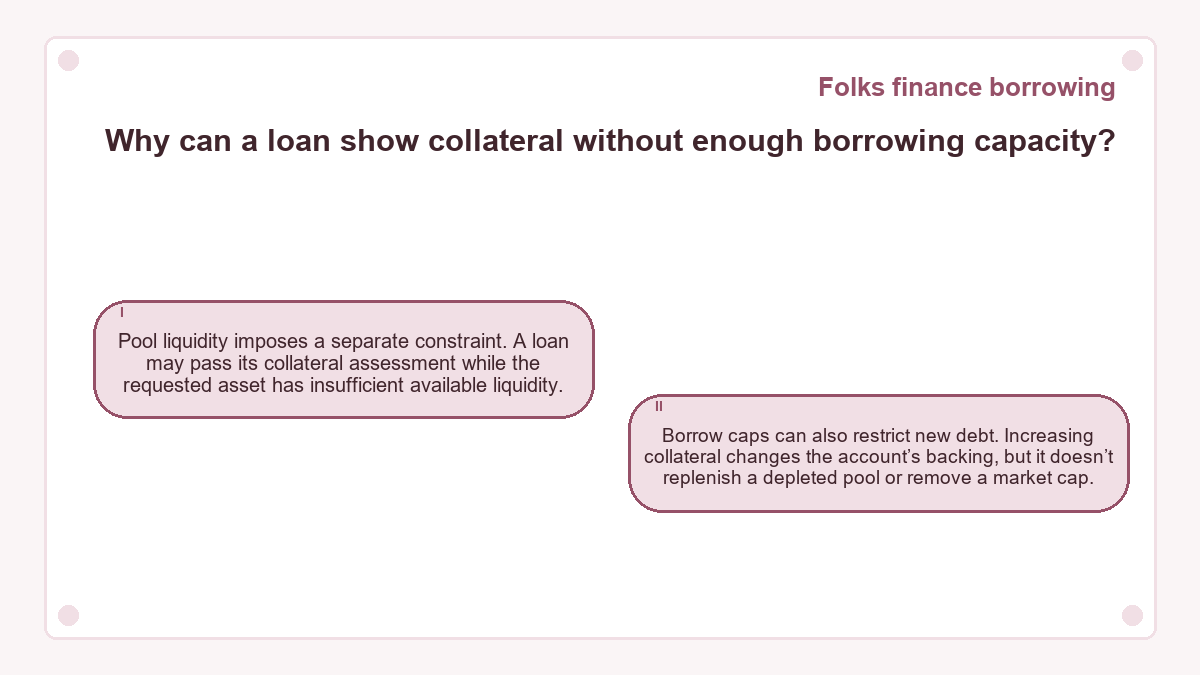
Why can a loan show collateral without enough borrowing capacity?
Collateral contributes only its permitted borrowing value, and existing debt consumes part of that capacity. Its full market value isn’t the amount available to borrow. The selected loan’s collateral factors determine how much each eligible balance contributes. Different collateral assets can therefore support different borrowing amounts even when their market values match.
Pool liquidity imposes a separate constraint. A loan may pass its collateral assessment while the requested asset has insufficient available liquidity. Borrow caps can also restrict new debt. Increasing collateral changes the account’s backing, but it doesn’t replenish a depleted pool or remove a market cap.
The capacity shown before signing is a snapshot. Price changes, interest accrual, and intervening pool activity can change the conditions execution encounters. A request must satisfy the applicable checks when processed.
Following a selected collateral balance into a borrow record
Consider borrowing against an eligible collateral balance in xChain, with the proceeds intended for a supported receiving chain. The normal path requires an account address registered on that chain. Collateral eligibility and address registration are prerequisites; the available amount and borrowing rate are live inputs.
| Stage | Record or condition to confirm | What can prevent progress |
|---|---|---|
| Select the account and loan | The intended account controls the selected loan. | A different account or loan shows unrelated balances. |
| Confirm the receiving setup | The asset supports the destination, and the account has a registered address there. | A missing registration leaves the receiving setup incomplete. |
| Commit eligible collateral | The collateral appears in the selected loan after processing. | An unprocessed collateral transaction hasn’t established the required balance. |
| Review the proposed borrow | The amount and rate choice satisfy capacity, liquidity, and applicable limits. | The requested debt exceeds an execution constraint. |
| Authorize the borrow | The wallet request matches the intended operation. | Rejected authorization doesn’t submit the intended borrow. |
| Confirm execution and delivery | The loan records the debt, and the receiving address receives the asset. | A source-chain transaction alone doesn’t prove destination delivery. |
| Retain the resulting position record | The debt asset, balance, rate type, and supporting collateral identify the ongoing obligation. | Recording only the wallet receipt omits the debt requiring repayment. |
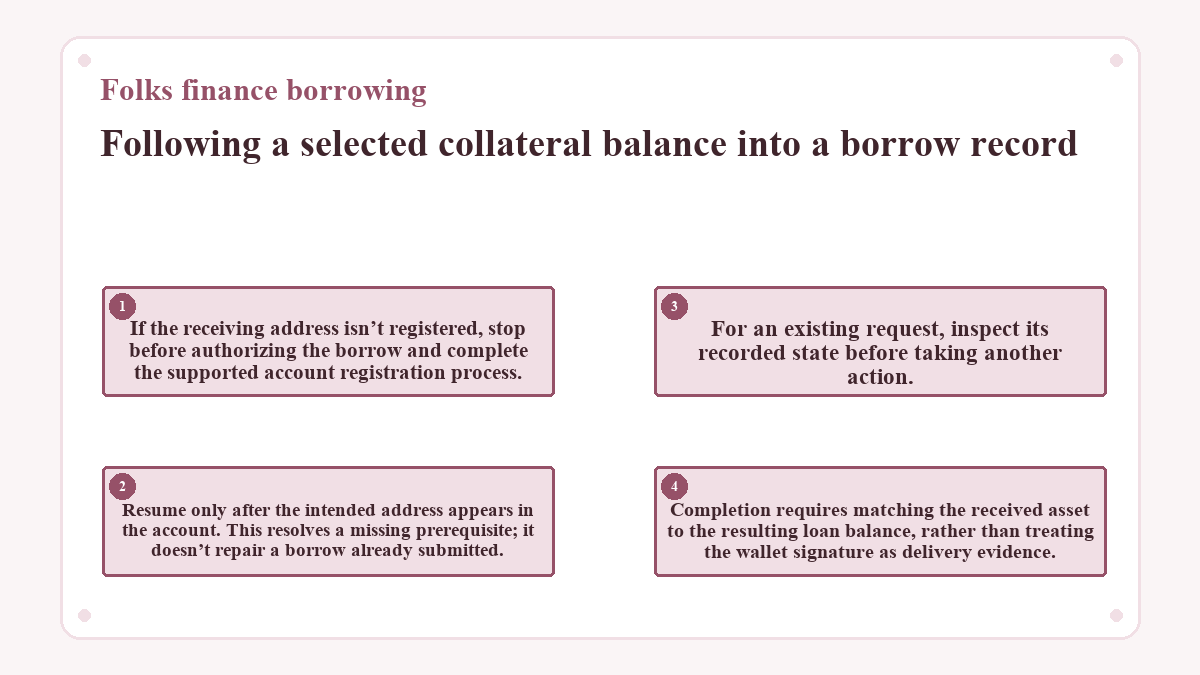
If the receiving address isn’t registered, stop before authorizing the borrow and complete the supported account registration process. Resume only after the intended address appears in the account. This resolves a missing prerequisite; it doesn’t repair a borrow already submitted. For an existing request, inspect its recorded state before taking another action. Completion requires matching the received asset to the resulting loan balance, rather than treating the wallet signature as delivery evidence.
What can change after the loan is funded?
Accrued interest increases the borrow balance, while changing asset prices can alter the relationship between outstanding debt and collateral backing. Spending or transferring the borrowed tokens doesn’t repay the loan. Its obligation remains in the account even when the receiving wallet no longer holds those tokens.
A loan becomes eligible for liquidation when its adjusted total borrowed value exceeds its borrowable amount. The gap can narrow because collateral loses value, the borrowed asset gains value, or interest accumulates. Liquidation exposes collateral to seizure under the applicable rules. Adding eligible collateral or reducing debt changes the position, but a pending operation doesn’t establish that the loan has already improved.
Interest accrual also means the original borrowing receipt won’t remain an accurate repayment quote. Use the outstanding balance when assessing the obligation.
Reading collateral factors and borrow factors together
A collateral factor weights the value supporting a loan; a borrow factor weights the debt assessed against it. These factors adjust the values used to assess borrowing capacity; they don’t multiply the token balance owed for repayment. For multiple collateral assets, the protocol adds each asset’s balance multiplied by its price and collateral factor.
On the debt side, it adds each borrow balance, including accrued interest, multiplied by the borrowed asset’s price and borrow factor. Both totals use a common value basis. Their difference describes remaining capacity in that basis, rather than a token amount immediately available for withdrawal. Converting it into an additional borrow also requires the chosen debt asset’s price and factor. The calculation method is distinct from its configurable factors and changing prices.
Repayment evidence and the remaining collateral
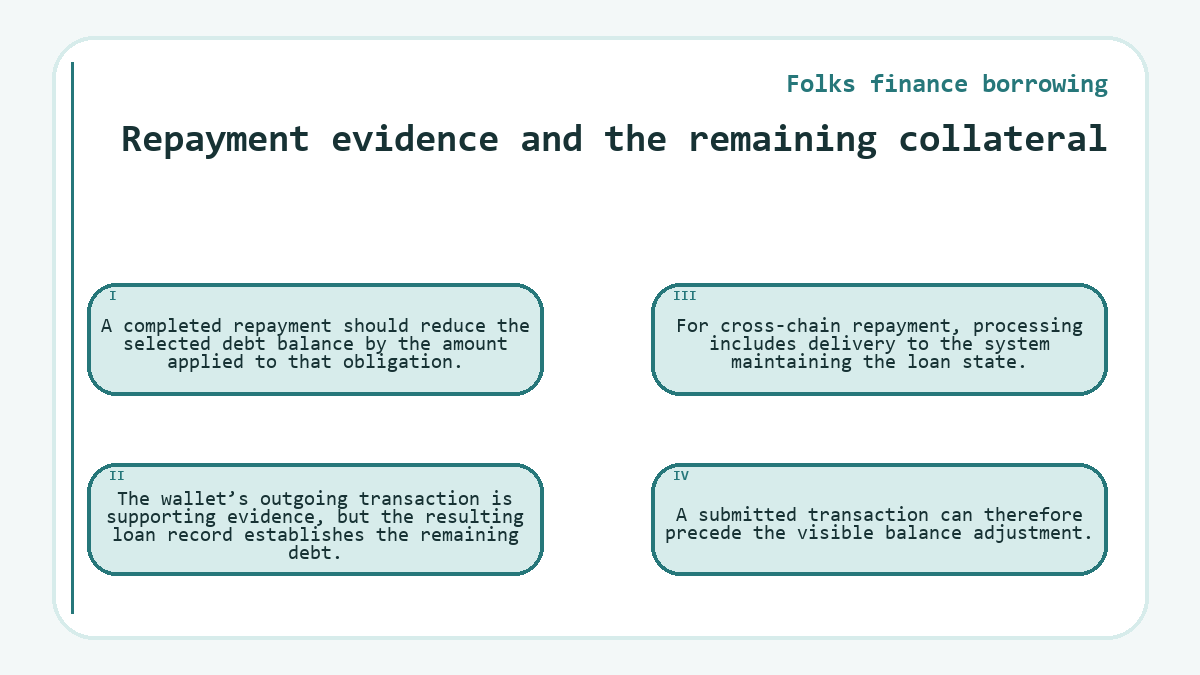
A completed repayment should reduce the selected debt balance by the amount applied to that obligation. The wallet’s outgoing transaction is supporting evidence, but the resulting loan record establishes the remaining debt. For cross-chain repayment, processing includes delivery to the system maintaining the loan state. A submitted transaction can therefore precede the visible balance adjustment.
Full repayment requires checking every outstanding borrow in the selected loan, including accrued interest. Repaying one asset doesn’t settle a different borrowed asset. Once no debt remains, collateral release still needs its own completed operation. The relevant records are the cleared obligation, the reduced collateral balance, and the assets received through that release.
Partial repayment leaves a smaller obligation to monitor. Full repayment removes that loan’s borrowing exposure once every debt is cleared; retaining debt while adding collateral leaves interest accruing.
Folks finance borrowing - your questions answered
-
Can an ordinary deposit support a borrow before it becomes loan collateral?
- A deposit must be assigned as collateral to the selected loan before its value supports that loan’s borrowing capacity. The Algorand app includes a move-to-collateral operation for existing deposits. A deposit balance elsewhere in the account doesn’t by itself establish collateral in the intended loan.
-
Does selecting a stable borrowing rate freeze the collateral valuation?
- A stable borrowing rate doesn’t freeze collateral prices or the value of the borrowed asset. It concerns the interest mechanism. The loan remains subject to collateral valuation and liquidation conditions, so a stable rate doesn’t make the position’s remaining borrowing capacity constant.
-
What can make stable borrowing unavailable while variable borrowing remains possible?
- Stable borrowing has additional constraints, including a cap on the size of a single stable borrow. A request can meet general collateral requirements yet fail those conditions. Availability depends on the selected pool and requested amount; changing rate type also changes the interest terms you accept.
-
Can one loan contain several borrowed assets?
- A loan can contain multiple supported borrows, which contribute to its combined debt assessment. Each balance carries its own asset price and applicable borrow factor. Review the individual balances as well as the total, since repaying one borrow doesn’t automatically repay the others.
-
How should I interpret Waiting Relay while adding borrowing collateral?
- Waiting Relay means the cross-chain operation is awaiting delivery to the hub chain. Collateralization can require source-chain finality before that delivery proceeds. Until the collateral appears in the loan state, a submitted collateral transaction alone doesn’t establish the capacity needed for a subsequent borrow.