Folks finance connects lending returns with borrowing demand
Folks finance provides crypto lending and borrowing across supported blockchains, alongside liquid staking and swaps through its Algorand app. Depositors supply assets to lending pools, while borrowers commit collateral to secure debt. Pool demand influences the interest each side earns or pays. Its cross-chain lending system coordinates positions across networks; xALGO staking earns rewards through Algorand consensus. These activities create different balances and obligations, so a completed transaction needs to match the intended position change.
On this page
Pool utilization affects both lending income and borrowing costs, while collateral requirements and available liquidity determine which actions a position supports.
A deposit becomes an interest-bearing balance
A lending deposit requires a supported asset, an available wallet balance, and enough network currency to cover the transaction. The chosen market determines which asset enters the pool. A token with a familiar name on another network isn’t automatically the same supported deposit asset.
Depositing moves assets into the lending protocol and establishes a balance against the pool. Wallet signing authorizes the transaction; settlement establishes its effect. After settlement, match the confirmed deposit transaction to the balance credited in the same account and market. An advertised annual yield describes earning conditions, not whether a particular deposit completed.
In the xChain app, a deposit initiated on a spoke chain can remain in Waiting Relay before the hub processes it. A source-chain confirmation therefore doesn’t always establish that the lending balance is ready. A pending message and a recorded failure are different states; repeating the deposit while its status remains unresolved can create a separate operation.
Pool utilization connects deposit income and debt costs
Utilization measures the share of deposited liquidity borrowers have taken, linking demand for loans to the pool’s interest rates.
Borrowing demand and available liquidity
The relationship is total debt divided by total deposits. Higher utilization generally raises borrowing costs and deposit returns through the pool’s rate model. It also leaves less liquidity available for withdrawals. A higher displayed yield can therefore accompany tighter access to deposited assets.
Deposit interest comes from borrower interest after the protocol’s retained share. For xChain lending, the calculation combines utilization, the weighted borrowing rate, and that retention factor. Deposit and borrowing rates needn’t match.
Variable rates and stable rates
Variable borrowing rates move with pool conditions. A stable borrowing rate is set when the loan is taken but can rebalance under specified protocol conditions. Stable therefore describes a rate mechanism, not an unconditional lifetime price.
Annual percentage yield, or APY, expresses a compounded annual rate. It’s not the return already earned. Comparing positions also requires their duration, accrued interest, applicable fees, and any separately identified incentives.
Depositing, borrowing, and staking create different positions
The principal choice is whether assets should earn lending interest, secure borrowed funds, or participate in staking. Each path changes what the account holds and what must happen before an exit. Liquid staking can also feed into lending, although combining them adds another position to manage.
| Activity | Position created | Condition governing exit |
|---|---|---|
| Lending deposit | A balance supplied to an asset pool | Withdrawal requires available pool liquidity; collateral commitments can restrict removal. |
| Collateralized borrowing | Borrowed assets and an interest-bearing debt | A voluntary full exit requires repaying the debt; removing collateral earlier must leave remaining debt adequately backed. |
| Algorand liquid staking | xALGO representing staked ALGO and accrued rewards | Unstaking redeems available xALGO at the protocol’s applicable exchange rate. |
A lending balance measures a claim against a pool. A loan adds an obligation, and a liquid staking token represents an underlying stake. Comparing their headline percentages alone misses these differences in asset exposure and access.
Cross-chain lending coordinates positions through a hub
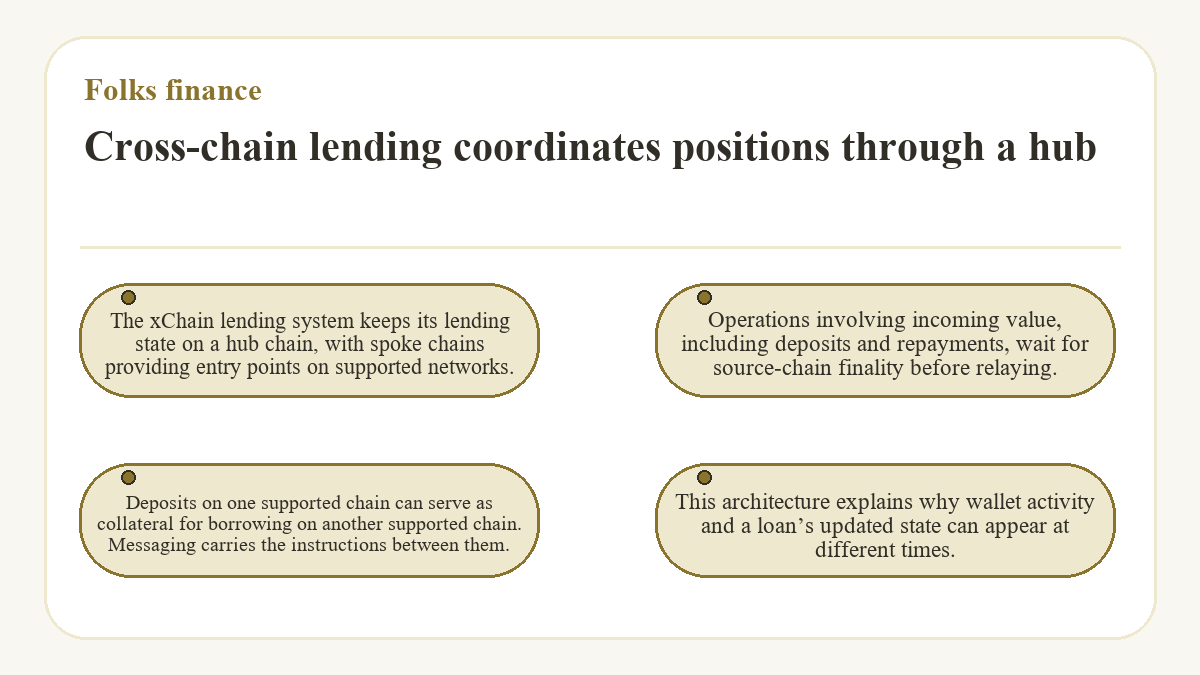
The xChain lending system keeps its lending state on a hub chain, with spoke chains providing entry points on supported networks. Deposits on one supported chain can serve as collateral for borrowing on another supported chain. Messaging carries the instructions between them. Operations involving incoming value, including deposits and repayments, wait for source-chain finality before relaying. This architecture explains why wallet activity and a loan’s updated state can appear at different times.
Collateral determines available borrowing capacity
Borrowing capacity depends on collateral value and the protocol’s risk adjustments, rather than the number of tokens deposited. A collateral factor determines how much deposited value counts toward a loan. Borrow factors can adjust the effective value of debt for risk assessment.
Collateral must be assigned to the loan before it supports borrowing. That distinction matters when a deposit exists but the loan shows no corresponding capacity. The deposit balance and the loan’s collateral balance describe different uses of the assets.
Prices and accrued interest can change a position after its opening transaction succeeds. Falling collateral value, rising debt value, or growing interest can reduce the remaining margin. When risk-adjusted debt exceeds permitted borrowing capacity, liquidation allows another participant to repay debt and receive collateral with a liquidation bonus.
Available borrowing capacity is therefore a changing limit. Removing collateral also consumes that margin, even when no additional assets are borrowed.
What does xALGO earn from staking?
xALGO earns value through Algorand consensus rewards associated with the ALGO staked in the liquid staking system. Accrued consensus rewards increase the underlying ALGO represented by xALGO through its exchange rate. This return comes from a different mechanism than interest paid by borrowers.
Staking exchanges ALGO for xALGO under the minting calculation. That calculation includes the exchange rate and an adjustment for immediate minting. Unstaking converts xALGO back into ALGO using the applicable redemption rate. Rewards fees affect the value accruing to holders, so gross consensus rewards and the holder’s return aren’t interchangeable.
The Algorand lending markets also support using xALGO as collateral. Ultrastake combines staking with borrowing to increase exposure. Its outcome depends on staking rewards relative to borrowing costs, alongside the loan’s collateral requirements. Successful execution establishes the leveraged position; it doesn’t establish that the position will earn a positive net return.
Swaps and lending pools extend how assets are used
The Algorand app combines lending with asset exchange and liquidity provision, allowing several operations to use the same underlying lending infrastructure.
Asset exchange through Folks Router
Folks Router compares routes across supported decentralized exchanges on Algorand. It supports split routing and paths containing multiple swaps. Integrated operations include Swap and Deposit and collateral swaps. The asset received, execution conditions, and applicable fees determine the economic effect.
Liquidity provision through lending Pools
Lending Pools use interest-bearing assets inside decentralized exchange pools. Their liquidity providers can receive lending interest alongside a share of swap fees. Providing exchange liquidity creates exposure to the pool’s asset composition, so this position differs from supplying a single asset to a lending market. The lending and exchange components both matter when interpreting its balance.
Temporary borrowing through flash loans
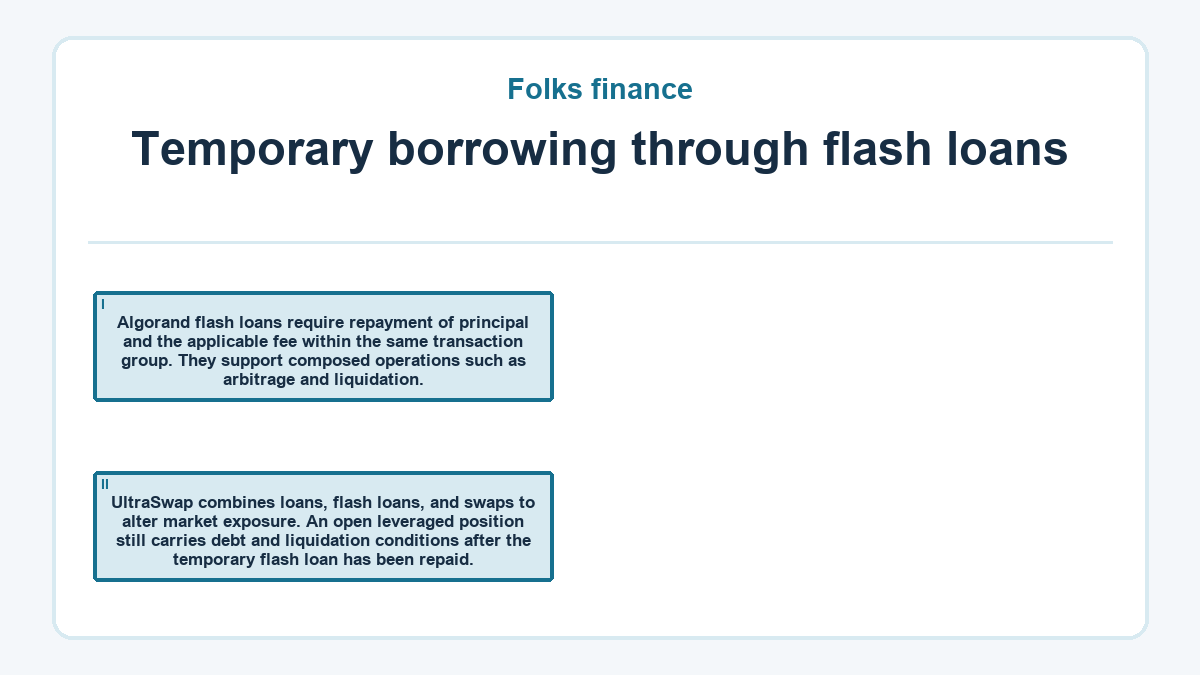
Algorand flash loans require repayment of principal and the applicable fee within the same transaction group. They support composed operations such as arbitrage and liquidation. UltraSwap combines loans, flash loans, and swaps to alter market exposure. An open leveraged position still carries debt and liquidation conditions after the temporary flash loan has been repaid.
Price feeds and transfer limits constrain protocol activity
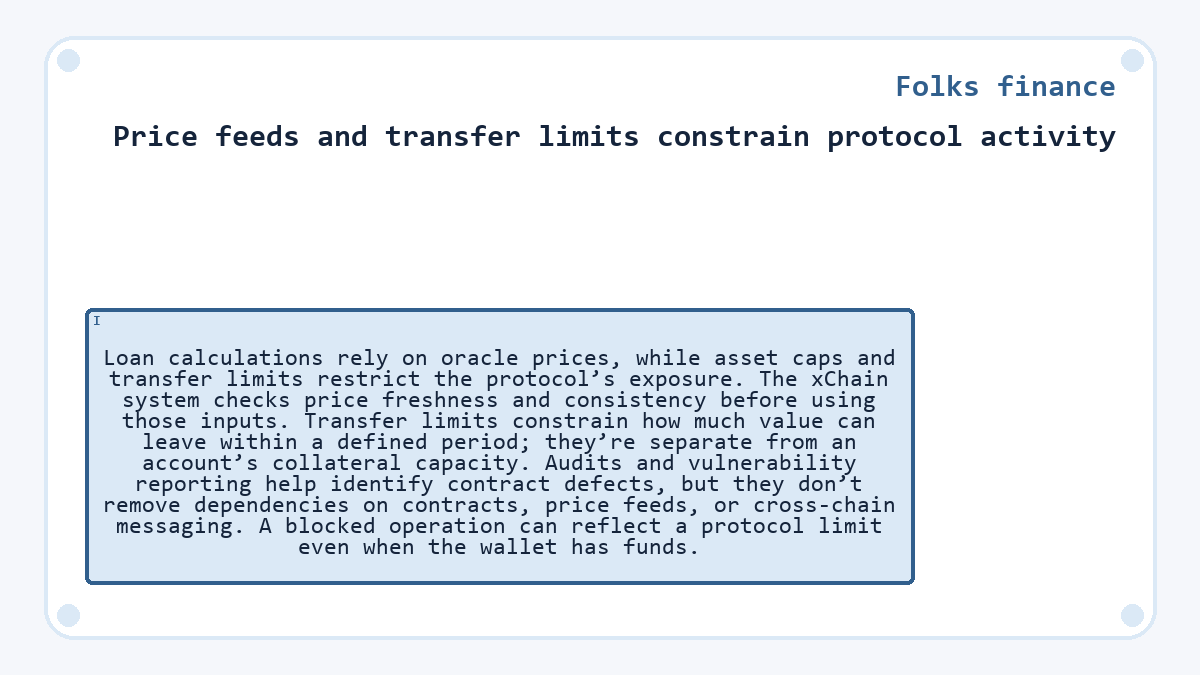
Loan calculations rely on oracle prices, while asset caps and transfer limits restrict the protocol’s exposure. The xChain system checks price freshness and consistency before using those inputs. Transfer limits constrain how much value can leave within a defined period; they’re separate from an account’s collateral capacity. Audits and vulnerability reporting help identify contract defects, but they don’t remove dependencies on contracts, price feeds, or cross-chain messaging. A blocked operation can reflect a protocol limit even when the wallet has funds.
Repayment and withdrawal leave different records
Repayment reduces a borrowing obligation, while withdrawal moves an available deposit out of the lending pool. Reducing collateral changes how much backing remains assigned to a loan. These operations have different effects, even when they involve the same asset.
A repayment amount must account for the debt accrued by settlement. For a full repayment, the meaningful result is no remaining debt in the relevant borrowing position. A transaction showing that funds left the wallet doesn’t, by itself, establish that outcome. Cross-chain repayment can await relay before the loan reflects the reduction.
Failed cross-chain messages have recorded recovery mechanisms, including retries and reversals where the operation supports them. Those mechanisms address failed processing; they aren’t a general cancellation right for completed transactions. Check the existing transaction’s message status before retrying or reversing it: these recovery actions apply to failed processing and only where the operation supports them. For an exit involving both repayment and withdrawal, verify both results: the intended debt reduction in the loan record and the withdrawn assets in the receiving wallet.
Folks finance: questions and answers
-
Can different wallet addresses belong to one xChain account?
- Yes. Linking connects addresses you control by automating the invitation and acceptance steps. The protocol also supports separate invitations for addresses in other wallets; the invited address must accept before joining. Once accepted, that address has the same account-management permissions as the original address.
-
What happens when a Folks Router swap exceeds its slippage limit?
- The swap fails if execution would exceed the permitted slippage. The tolerance defines the price movement the transaction accepts between its quotation and execution. The rejected Algorand transaction group neither exchanges the assets nor charges that group’s network fees. Fees from any separately confirmed transactions remain paid. Raising the tolerance permits a less favorable execution price; it doesn’t restore the earlier quote.
-
Does an Algorand deposit require ALGO when the deposited asset is another token?
- Algorand operations require ALGO for network fees and applicable minimum-balance requirements, even when another asset is being deposited. An operation can contain several transactions, so its total network cost can exceed a single transaction’s fee. Asset opt-ins and application-related balances can also reserve ALGO that isn’t available to spend.
-
Can collateral repay a loan without supplying the repayment asset separately?
- The Algorand app supports Repay with Collateral through its integrated swap functionality. This operation uses collateral to obtain the asset needed for repayment. The exchange outcome and fees affect how much debt it can retire. It also reduces the collateral remaining in the position, so the resulting loan must meet the applicable collateral requirements.
-
Why can an xALGO token balance stay unchanged while staking rewards accrue?
- Rewards accrue through the ALGO value represented by xALGO, so earning rewards doesn’t require an increasing xALGO token count. The relevant change is the exchange rate between the liquid staking token and its underlying asset. A separate lending deposit involving xALGO can have its own interest accounting, which shouldn’t be confused with the staking token’s reward mechanism.